Climate Risk in B.C.
The conversation around real estate in British Columbia is undergoing a structural shift. Climate risk is no longer peripheral to valuation and decision-making. It is increasingly embedded in pricing, underwriting, and transaction viability.
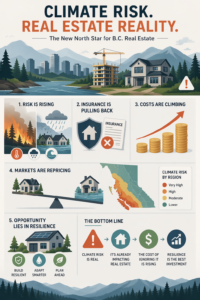
Across the province, the frequency and severity of extreme weather events have intensified, as demonstrated by the 2021 atmospheric river floods that severed transportation corridors to the Lower Mainland and successive wildfire seasons affecting Interior regions. These events are not isolated shocks but part of an emerging pattern of systemic risk. Property damage, displacement, and infrastructure disruption are becoming material considerations, with direct implications for liquidity and market confidence. One of the most immediate impacts is insurability. In designated high-risk zones, coverage can be restricted or withdrawn, which in turn compromises mortgage approval and the ability to close transactions. This linkage between climate exposure and insurance availability is now transmitting risk into pricing and affordability.
Cost structures are adjusting accordingly. Insurers are recalibrating premiums to reflect escalating claims associated with climate-related losses. In higher-risk geographies, this can result in significantly higher carrying costs or limited coverage options, both of which influence buyer demand and long-term asset performance. Forward-looking analyses indicate that continued development in floodplains and wildfire interface zones could generate billions in incremental annual losses, reinforcing downward pressure on risk-adjusted valuations.
Markets, however, are adaptive systems. Buyer behaviour is already evolving in response to these signals. There is a measurable shift toward properties in lower-risk micro-locations and toward assets that incorporate resilience strategies. Construction features such as fire-resistant materials, enhanced drainage systems, and passive cooling design are transitioning from optional upgrades to core value drivers. Site selection is similarly being re-evaluated through a risk mitigation lens.
Institutional and regulatory responses are also advancing. Improved hazard mapping, enhanced disclosure frameworks, and more rigorous resilience planning are increasing transparency and enabling more informed decision-making. At the same time, developers are facing growing pressure to deliver projects that are both climate-resilient and insurable, aligning design with emerging underwriting constraints and investor expectations.
For buyers, the implication is not a diminished opportunity set but a recalibrated due diligence process. Climate exposure must now be assessed alongside traditional factors such as comparables, strata documentation, and neighbourhood dynamics. Floodplain designation, wildfire interface classification, and insurance market conditions are becoming critical inputs in acquisition strategy.
The conclusion is straightforward. Climate risk is being internalized as market risk. Buyers who incorporate this reality into their analysis will be better positioned to preserve value, manage downside exposure, and capitalize on the market’s ongoing repricing of risk.